HOW INFLUENCERS LIKE BROOKE RAYBOULD THINK ABOUT THE INTERNET
When I think about extracting wealth from everyday situations—from what you already have on hand, I think of Mom influencers like Brooke Raybould.
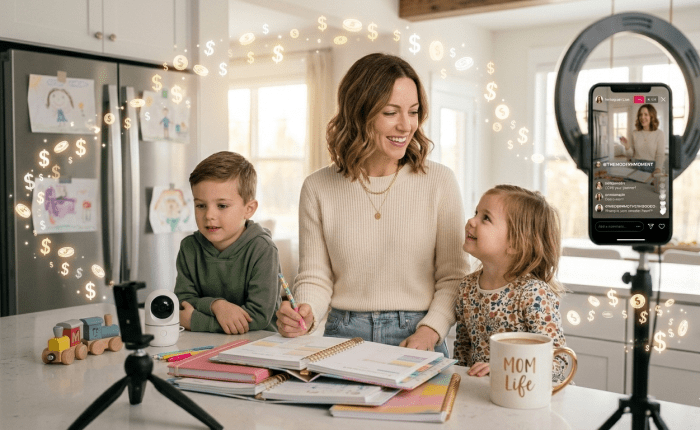
She was recommended to me in 2021 because of her location at the time. She was living in Virginia and we live in West Virginia. She posted lots of content related to her day-to-day life of raising 3 boys (she now has 5). She would showcase her morning routine, waking up at 5am, cold showers, journaling and lots of prep before her boys woke up. She was into fitness, exercise and healthy food. I appreciated her emphasis on hard work and self discipline.
I really enjoyed her crisp, professional content. It was highly digestible but somehow motivating. What? A mom just discussing her life on the internet and she was getting popular and likely making cash from advertisers and/or affiliate marketers? She would discuss Andrew Huberman—someone I was already listening to and learning from. It made me think—wow, I could be her! I already do most of what she is parroting and I have 3 young kids too! It kind of gave me hope as a stay-at-home Mom who only works 2 days each week.
Because she had such “Big Picture” thinking, she had a vision for herself and her family.
She found a way to tap into the digital space. You could tell her mind was whirling—how can I extract money from all of these Moms—not to mention lurkers, passive scrollers, gawkers and from the “This is cringe content” folks? These are the same people who have ZERO energy to use on their own content output but somehow have loads of time to scroll, offer lengthy detailed opinions, and basically sit back and judge a successful enterprise on a day-to-day basis.
Brooke could see that so many people were simply using the internet as a passive, click and scroll place—not as a place for wealth growth. She could see people clicking on her pretty pictures and cute videos of her boys. All she needed to do was create and cultivate her “Mom Brand” so to speak, and voila—even more cash pouring in as advertisers and marketers took notice!
There are psychological elements of comparison that Mom influencers unintentionally (or intentionally) tap into. Because humans are basically hardwired to compare, an influencer like Brooke Raybould can trigger this and gain a huge audience as well as advertisers and affiliate endorsement deals.
She writes her own Disney Family Guides and offers other courses. She is also in the throes of a book deal right now (2026) because she can use her big influence to sell more copies of her book to her followers first and then this pushes her book up in search for non-Followers and just regular readers of self-help books. Who knows, because of her 1.3 million following on Instagram, her self-help book could become a New York Times Best seller.
The reason I think I’m especially intrigued by Brooke as a sensational, money-making Mom influencer, is because I had a time in 2011 where I suddenly started to make money by posting videos on YouTube.
At the time I honestly HAD NO IDEA that I could make money posting YouTube videos—let alone hundreds of dollars each month! Once I started making money on YouTube, I saw the entire internet differently. It was motivating to make YouTube videos because I was paid for it! I received endless negativity, anxiety-riddling discomfort and the DISLIKE BAR was huge then!
Amidst all criticism, Brooke Raybould has certainly discovered this same secret that I discovered. While we all tacitly know they get $$$ we don’t discuss it enough. We almost act as if they are just “doing it for fun” or “as a hobby” when we go onto Instagram and are confronted with their content. It’s there. It seems harmless, so we “dwell” for a bit. Dwell time is the most CRUCIAL METRIC in the META 2026 Algorithm.
Some of us don’t mind the realization because we are often mindless in how we eat as well as how we use our time. Brooke Raybould is INSANELY motivated by the underlying dynamics of the internet (and by human nature). She knows how to extract resources there. She jumped into her entrepreneurial suit in full force. While people laugh at how she “displays her children for all to see” she is laughing all the way to the bank.
Mom influencers AND THE MOM/FAMILY NICHE ARE THE MOST LUCRATIVE CATEGORY ON THE INTERNET RIGHT NOW BECAUSE THE MAJORITY OF HOUSEHOLD PURCHASES ARE DONE BY MOMS. 2026
But if we could realize how precious time was, wouldn’t we just be focusing on creating our own content on a regular basis? Someone like Brooke WOULD NOT BE SUCCESSFUL if every single person was busily creating their own content and diving deeper into their blog writing, posting their own unique carousels, pictures or reels on Instagram or thinking of well-written, thoughtful blurbs on their Facebook page. All of these have the ability to gain traction, but they require consistency and emotional regulation (because you won’t grow fast and it can be a struggle before your account experiences the “Snow Ball” effect).
When your time and energy is used on the act of creation, it takes time away from scrolling. I can guarantee large content creators spend little if any time on the content of others.
That’s right, your time and attention is basically paying for these big influencers. They are making money from how you use your time.
Here’s the thing about Brooke Raybould, she discovered early on how much her time online could be worth if she used it to “CREATE HERSELF” instead of use it to consume media. This is the deepest realization that we all know but refuse to admit in our own lives. Meanwhile, we all still seem to want to get rich.
Even though the social media and content creator space appears to be saturated, always remember this: it is always going to be easier to scroll and do nothing than to create content.
Coming up with your own ideas, executing them until you reach a “physical thing”—an output, is going to be more of a hurdle. There’s just more friction involved. Brooke Raybould becoming her own “MOM BRAND” was a tough hurdle. She worked hard with her content. She continually thought of unique ways to use herself, her kids and her everyday life as a means to “keep people dwelling on the internet” and to keep advertises or affiliate marketing businesses interested. She has gorgeous blue eyes. Her children are adorable and well-mannered. She has a beautiful house in Texas. All of these things are crucial to her success, but she still has to put the work into making regular digital content and USING HER EXISTING MATERIALS.
It’s just easier to pick up your phone and scroll through what’s already out there. Ready-to-click on podcasts will always be easier to listen to. Facebook will always be ready for a quick scroll.
Because of the work required to create social media content and BECAUSE OF BOTH THE STIGMA OF BEING A CONTENT CREATOR and the common (negative perception) that creating social media is “nothing” or “isn’t working” or “isn’t actually a job”, THERE WILL ALWAYS BE SOME KIND OF SPACE FOR CONTENT CREATORS. It still requires some degree of effort to keep people on the platform and to keep them engaged.
There are still too many people on the planet who are embarrassed to put themselves out there and make mistakes, expose their ideas and content to judging family and friends (who love to gossip about your content behind your back) or give you those quiet looks of calm rejection when they encounter you in person.
You have to sit and think about why you desire wealth so much. Is it for status? Do you wish to project to others that you have finally made it—you’ve leveraged your skills and your existence to create something from nothing? Do you have specific interests that you would like to fully pursue and these require a higher income? Perhaps you have personal debt or even family members who need financial assistance.
Do you have an innate, personal need to see yourself as someone who has finally understood the BIG PICTURE regarding a situation, system or idea that now you can capitalize on? Because you see it from a macroscopic perspective you can find a unique path to extract resources from it. You know how it works and why it works. You know the underlying structure. You know what causes what in this system. Your mind finds a unique angle where it can gain value…and then you sell that value to others in new ways.
My prediction is that the digital market space will possibly be the biggest market space of the future. Influencers are jumping in on this cultural paradigm now and getting their “real estate” while costs are low and distribution (I think of it more as visibility) is still relatively high. It’s not a hobby. It’s a way for anyone with a creative mind-set to make money.