MY REEL WENT VIRAL

MY REEL WENT VIRAL

MY REEL WENT VIRAL: The Content Creator Mindset

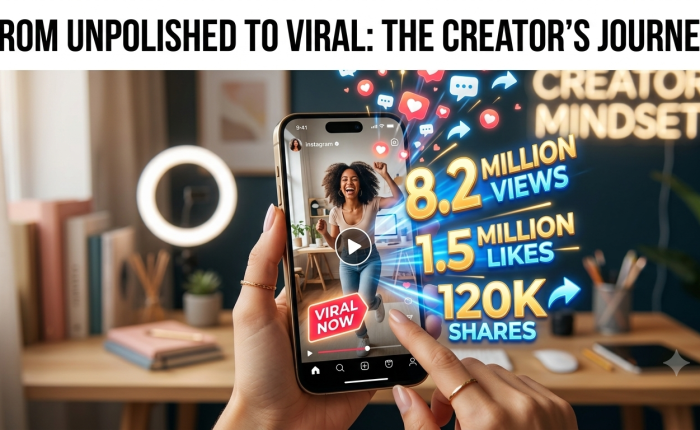
A couple weeks ago one of my Instagram reels went viral on BrightCardboardLife. I shared it with my 300 Instagram followers and a week later I had approximately 260,000 views and around 22 thousand likes. Today it sits around 350,000 views and continues to grow. For a nano Instagram account, that reel is definitely on the viral track.

Since I went viral back in 2011 on a super small YouTube account, I asked Gemini what are the chances of going viral again in June 2026? I was surprised to find out that going viral (especially for small accounts) is quite rare. The chances of going viral twice on two different platforms is 1 chance in 160 million.

GOING VIRAL A SECOND TIME made me want to dig deeper into the digital creator spaces and the mechanics and metrics of these platforms. I wanted to learn as much as I could. Here are a few thoughts that I distilled—albeit roughly—after some of my research.

1.Even though the social media and content creator space appears to be saturated, always remember this: it is always going to be easier to scroll and do nothing than to create digital content. This has been my mantra for years.

2. Coming up with your own ideas, executing them until you reach a “physical thing” or an output is going to be more of a hurdle than picking up your phone and scrolling through social media, listening to your favorite YouTube podcast or simply reposting someone else’s meme, reel or political rant. This means people who consistently create than consume will always have the upper hand.

3. There are two major psychological factors at play for a digital content creator: The FIRST psychological hurdle is this: There is the stigma or “negative perception” about digital content creation—especially by people whom you interact with in everyday life. These are the people who lurk or find out about your content.

 These people think digital content creation “isn’t really work” and so they undervalue it and disrespect anyone struggling to create content who hasn’t “Made it yet”. For the bigger accounts they chalk those up to “Well, they have a big account and they know what they are doing” etc. Or, they say “Well they’re professionals and they’re making money, so that’s different.”

The SECOND psychological hurdle is this: Most people are WAY too embarrassed, fragile and vulnerable to be a social media content creator. First, you have those friends and family who are actively discouraging you and gossiping behind your back as you make your efforts. Even more, you have strangers who, in the comment section, will publicly humiliate your own digital creations—your reels, photos, text or blog posts or any ORIGINAL digital media YOU produce.

4. But here are some very interesting facts you should consider:

Facebook is largely considered an “empty room” by many people. We see it as dead. Nobody goes there anymore, right? All our close friends BARELY POST ANYMOE and when they do, they repost someone else’s text post (copy pasta) reel, article or goofy picture

 The surprising truth is that while it appears that Facebook is largely a ghost town, the statistics reveal that it is STILL A HEAVILY USED PLATFORM. The same number of people are still passively scrolling but FEWER PEOPLE ARE USING THIS PLATFORM TO POST.

Do you know what this means? It means that you can CAPITALIZE on the SECRET LURKER PHENOMENON that is going on behind the scenes. As I type these words, I want you to:

  1. Spend less than 1% of your time checking your views or follower numbers. These numbers fluctuate.
  • Spend 99% of your time creating, curating and adjusting your content. Keep trying variations to see what works best for you.  Try reels, photos, solid backgrounds with text, intriguing quotes, photos with BOLD WORDS to freeze the scroll.
  • Be fearless to post. You know why? I can guarantee that almost everyone is scrolling by so fast by mine (and your) posts almost instantly. The statistics reveal that most content is swiped by in 1.5 to 3 seconds—and 3 seconds is long these days. The hardest part is getting someone to idle on your piece of digital content for more than 4 seconds.
  • Always come up with original ideas; post your own impressions of the world around you—whether it be your children, your home/yard, a block of text about an idea you were thinking about…how you’re adapting to a new diet. THE LIST IS ENDLESS. Just make sure it is coming from YOU and you are offering your own “Take on it”. The common theme is YOUR OWN ORIGINAL THOUGHTS/PICTURES/VIDEOS/CONTENT.
  • STOP REPOSTING OTHER PEOPLE’S CONTENT ON YOUR PUBLIC ACCOUNT. If you want to grow on any social media platform these days, your content must be traced back to your own mind. Meta (the parent company who owns Facebook and Instagram) actively suppresses reposting other people’s text blurbs (copypasta), articles, reels, political articles or funny memes. Meta marks you as a REPOSTER. In other words, you get flagged by the system as not generating your own original content and only a very small group of people (if any) will ever see your posts. Your chances for growth are stagnated.
  •   Making content is hit or miss. Some will resonate with people and do well in views and shares. Other pieces of content will fizzle out quickly. Just remember that this is true for any digital creator, even the most successful ones.
  • Be consistent with your digital content production. Remember you are creating a digital asset that will serve as future digital real estate. Digital assets can be leveraged for advertising, or creating a funnel towards other things that you might be selling. Pushing traffic towards an underlying business, book or piece of artwork is sometimes the ultimate strategy. BUT YOU MUST BUILD A DIGITAL ASSET FIRST TO GET ANY TRAFFIC AT ALL. Do you get how this works?
  • Do not worry as much about follower numbers as you are about organic views and traffic. You want your content to reach engaged viewers. If the data reveal few views—even your own followers are unlikely to be interested in your content and the algorithm will give you a bad score for your account or at least for the next posts.
  • The 2026 Algorithm focuses on raw, unpolished content. This content is vulnerable. It can seem embarrassing or humiliating. The EMBARRASMENT TAX happens to anyone who is actively building digital content in the face of judgmental onlookers.
PEOPLE TELL YOU NOT TO POST CONTROVERSIAL OR PROVACATIVE IDEAS ON FACEBOOK

PEOPLE TELL YOU NOT TO POST CONTROVERSIAL OR PROVACATIVE IDEAS ON FACEBOOK

This is something that I want you to remember: the next time someone tells you not to post a controversial or provocative Facebook post or the next time they chide you “Facebook is not the place”, you can remind them of this:

  • Nobody (or, almost no one) reads a dense non-fiction book to completion. They skip around or don’t finish it.
  • Fewer people are reading lengthy articles on the internet of any kind.
  • Fewer people are reading at all.
  • When people are “reading” they’re usually scrolling and capturing quick, short bits of information in a hurry.

The next thing you can mention is the EVIDENCE STRONGLY SUGGESTS that people spend LOTS of time hovering over and READING comments from various Facebook posters/accounts, especially if the posts are intriguing, controversial or even just slightly provocative.

I’m not talking about near nudity or explicit posts that generate the SAME kind of expected commentary. I’m referring to written posts that nudge people to read and then respond with their own intellectual take or perhaps push back with a logical and fact based retort. People are often considering all the other comments before posting their own. They don’t want to sound like they’re just repeating the same thing but have taken the time to think about the various comments and have arrived at a slightly nuanced angle. In other words, they END UP SPENDING MORE TIME on that post with lots of comments.

People are naturally curious. People also don’t always have the time to plow through a dense book that may be regarded as controversial. But somehow Facebook analytics and all the research we have until now suggests that people DO spend quite a bit of time in comment sections. If they’re not actively responding, their passively reading. And posts that make a person think for a moment will always generate more engagement, more time spent on that post.

This nonsense BS that FACEBOOK IS NOT THE PLACE TO POST SOME IDEA is NOT backed by evidence or what people are ACTUALLY engaged by or act upon. By far, Facebook is the place because people are more likely to be actively scrolling through Facebook than to be flipping through the pages of book–even if the book is controversial or engaging.

We need to rethink the common phrase “Facebook is not the place”. If you’re a digital creator, Facebook is most certainly the place. Of course you can lose followers but your reach directly expands for potential new followers or friends. Also, the algorithm constantly takes notes. It sees beyond quick likes where people scroll past rapidly vs. people hovering and reading and actually being fully immersed in a post or a string up comments below the post–even if they don’t click “like”.

I recently discovered that length of time spent is a STRONGER INDICATOR of reach and engagement than likes. Someone won’t like your post but they’ll hover over it and spend their precious time on it anonymously. Always remember that. The algorithm knows.

So if you have any interest in success measures like MAKING MONEY $$$$$$ or building a FOLLOWING in the digital sphere, you’ll need to rethink these overused expressions that really don’t have any bearing on reality.

SOCIAL MEDIA “CREATOR TYPES” ADVANTAGE!

The SOCIAL MEDIA SPHERE may already be saturated with accounts.

Here are a few things to remember while you’re vying for presence, subscribers, followers, noticeability, views and engagement:

It will always be easier to CLICK and SCROLL and CONSUME than to CREATE and to create regularly.

There will always be MORE PEOPLE in the population willing to waste several minutes of their day (and from the research literature, SEVERAL HOURS) scrolling than several minutes CREATING. Always. This is a fact. The most rudimentary fact of human nature is probably our tendency towards ease. We have an entire country filled with health problems and obesity, not bodybuilders. And most of this can be attributed towards our human tendency towards relaxation, comfort and often laziness.

Humans choose the easier path. This is good otherwise we wouldn’t have invented technology in the first place. But this is also good for YOU because it means that you as a content creator or blog-post writer or aspiring influencer have a distinct advantage.

Remember, you want to create. You LOVE the process, the act of creating both physical items and digital items. You’re spurred not solely by gaining some kind of number or position but simply by the fact that you love the creative flow you experience while making anything. You know what this feels like. You’ve done it before. You know how much better you feel after you’ve put in some effort. Sure, you’re flawed. Sure, other people will notice too, but you’re on this creative trajectory.

Think of it like this: some people try to acquire a college education for the sake of getting good grades or simply for the high paying career at the end. Other folks pursue education because they enjoy amassing tangible and abstract truths about the world. They love the interplay between disparate things. They love the “Aha moment” when they discover a useful link with something they’ve learned. They learn because they know it enriches their character, performance and intelligence. Learning becomes a long-term life goal.

In the same way, creator types who want to create and have that instinctive drive to create, are not motivated by gaining a following or establishing some kind of internet notoriety or making lots of money.

While it may be fun to track your progress and to see the views you’re getting, it’s even more fun to jump back into the act of creating, producing and synthesizing relatable ideas.

As much as I try to take a break from posting on various social media platforms, I find myself inexorably compelled to create and post whether it is my art attempts, my woodworking creations, my decorations, my gardening activities, my children’s summer fun moments etc.

I enjoy the process of making original stories on Facebook or composing short reels. I like posting on my ART facebook page. I like wrestling with my thoughts in my blog. I like attempting Shorts on Youtube every-once-in-a-while. I have an entirely separate blog where I posted philosophical ideas for YEARS and it has almost 300,000 views but only 98 subscribers. And, while I haven’t posted there for over a decade, I’m still gaining views! My 2009 posts are still getting views.

If the above felt relatable, you know you’re certainly a “creator type” and you have an edge already. You have intrinsic motivation and nothing can ever take that away because you’ve felt it too many times before. You notice you spend hours making things but only minutes (or less) scrolling. If that’s you, YOU HAVE WHAT IT TAKES!

Think of all the BIG content creators out there. Do you think they spend a ton of time or effort scrolling through other people’s content? My guess is RARELY. They’re going to have to spend tons of their time working on, editing and thinking about THEIR NEXT PIECE OF CONTENT. It becomes a constant pursuit for them. And believe me, when they start to grow, it’s even more time consuming. So NO, they’re NOT SPENDING VERY MUCH TIME SCROLLING. I can guarantee where they’re spending their moments. They spend their time thinking about their projects and tossing around ideas for their next one.

The only thing you need to do is to convert SOME OF THAT TIME STARING AT YOUR PHONE BRIEFLY ON THOSE BIG ACCOUNTS TOWARDS directly working on your own projects. It’s a habit that you must inculcate into your brain. If you’re going to spend any time in the social media sphere, always do it for you!