
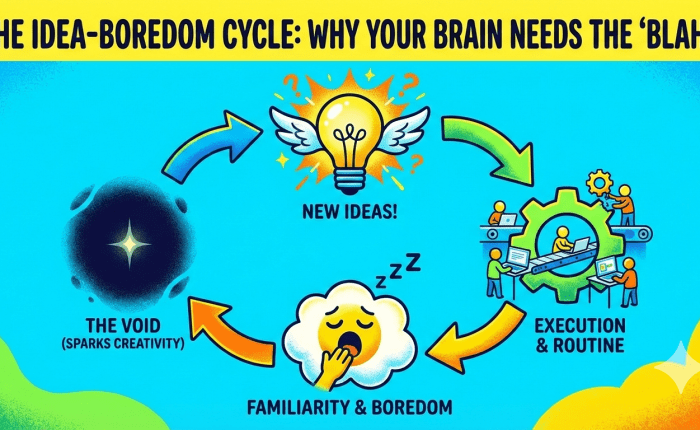
For me I define boredom like this: It’s when you must be fully engaged and present and actively working on a project…AND it is always a monotonous one, one that you must FORCE yourself through.
Working at a pre-K twice each week has really shown me what boredom is. You have to be engaged in the scheduled activities of the two-year olds. You’re going through all the motions and unlike an arduous hike where you get to view the gorgeous scenery at the summit, or a workout where you feel the biological surge of blood flow and adrenaline as well as the knowledge that you’re actively improving your physique and making a difference in your health, working with two year olds you feel like you’re just keeping them in the right place. Your attention isn’t free to wander; it is consumed by each child’s every second impulse to throw something or to escape. Also, you’re not really getting to see the progress that they’re making because they won’t be with you next year and they’re someone else’s children.
Lately I have become fascinated by whether boredom can have an impact on motivation levels. Could it help develop the right mental framework for experiencing the dopamine drive, the feeling to engage in a task and to enjoy doing it? Could it bring about new ideas?
I am actively trying to lean into boredom. I want these moments of boredom to fill my days so that I can be more creative and come up with a variety of useful and novel ideas. I’m using boredom as a tool to ultimately sharpen my senses and my experiences.
Just as buying more lottery tickets increases your chances of winning, more ideas increase your ability to generate more ideas from your subconscious. These are the kinds of ideas that can be streamed into the pipeline of your awareness. The more of these you have, the more likely you are to come up with an original synthesis. This could be an invention, business idea, or a strategy to do something that no one has ever thought of before.
It’s absolutely fascinating to consider that all the raw materials of the universe surround you on a moment-to-moment basis. But these must be extracted from the chaos; they must be rearranged. You can come up with something out of the drudgery of your own life and produce an original idea.
Let’s pivot back to boredom. The more I learn the more I see that punctuating your day with 20 minutes of monotonous boredom is a recipe…a conduit to having divergent thinking. Only then can you piece the strange or unseemingly disconnected thoughts together.
It’s the fusion of ideas that we desire. Often, it’s a problem that requires a solution.
Say, you don’t like the way your house looks. Or, you don’t know how to attract more followers to your Instagram account. Maybe you really want to figure out a way to develop a line of interesting home decor items that reflect your aesthetics, your artistic tastes and personality. Perhaps you want to figure out a way to make more friendships and more personal connections in your day-to-day life.
One of the interesting things about our brains is that when we are truly bored, when we’re going through repetitive thoughts our brains default mode network activates. This is considered the opposite of executive function. If executive function is when your brain is engaged in a complex and detailed thinking, the default mode network is when you’re NOT attempting complex or detailed thinking…you’re not doing high level math or constructing elevated literary prose. These require lots of conscious effort. They need the management of your attention so you can retrieve information from your memory to compose or create something or understand something.
How do you know when the default mode network turns on? The best way to know is if you suddenly hear the voice within your head. You hear not just the ruminating thoughts about “what you should have said” or “why did she say that to me?” but you hear things like, “Maybe I should turn one of my living room walls into a “Butterfly Wall” with lots of pictures of butterflies.
In other words, when the default mode network arrives, random ideas start coming. Ideas that may or may not be useful. You will notice that they start to flutter through. They are allowed through the gate because you have deactivated the main executive controller—the pre-frontal cortex. You’re doing mindless tasks like folding laundry, going for a walk, taking a shower, or washing dishes. A new idea comes at you. You think, ahh, maybe I should try that…maybe I should research that phenomenon? Maybe I should write about that phenomenon! When these kinds of thoughts start coming, you know you are in the default mode network.
When you’ve finally arrived (and ANY music, listening to podcasts or beeps from your phone will not help you get there as quickly) you need to know that this is where interesting connections between ideas are made. This is where the real MONEY-MAKING CONCEPTS HAPPEN.
Different things that your subconscious may have picked up at different times of the day or days ago or even weeks ago may spontaneously bubble up and combine to make a very wonderful idea. This is where inventions happen. This is where powerful plots to movies break out, where two pieces of disparate data reproduce a new concept. Sometimes these concepts are quite useful. They may help resolve in earlier conflict period you have been dealing with.
New approaches, new inventions, new paintings, new business plans, new plots to novels or plays or gardening landscapes develop in this state. They make themselves tangible to your conscious state brain.
This is exactly why periods of boredom, monotony, and stillness end up giving you such a wildly incredible edge. But it makes total sense! You can’t understand brightness without the dark, and you can’t see the bright ideas without the simultaneous background of monotony…your own feelings and experiences of deep boredom. Yes, going through repetitive motions will get you there.
It is a literal fact that your brain will start to conjure up its’ own unique creations if you let yourself step into boredom and monotony on a regular basis. You need this kind of “contrast state” to push your brain to rearranging and re-managing itself as it works with less stimulation.
I can attest to these many times over the course of my life. The times where I really allowed boredom to prevail, the more likely my brain could reconfigure itself, bring up storage boxes from the basement, so to speak. More storage boxes to look through? More stuff for it to work with!

 A Slice of My Trash, Travels and Tots