You probably have more options than you realize. You probably have more reach. With the modern digital landscape, you can be influential because your ability to expand, grow and be recognized by a larger number of people is so much more ample. Meanwhile, your everyday life experience may be limited by the number of people you encounter and form both shallow and profound relationships with.
Dunbar’s number suggests that most people interact with and form stable relationships with 150 to 300 people in their life (and that’s a generous range!). The problem with these 150 to 300 people that we mostly see and interact with is that they provide a very limited “small pond” effect to our brains. This is a cognitive bias.
Thus, in reality, we interact with a VERY SMALL FRACTION of the global population. It’s impossible for our brains to internalize the vastness, the scale of it all. Instead, we rely on our limited understanding to gauge the world–especially OURSELVES IN THIS WORLD. Our thoughts regarding our opportunities, chances and options are simultaneously shrunk down to size.
We start to judge ourselves based on the overall tenor and consensus of how these 0.00000375 people in the global population respond to us. We’re constantly worrying about our character and how it is being perceived, evaluated, from the metrics coming from that very small population we are working with. For example, if we get fired, a few times (or even many times!) we assume our experience of ourselves is representative of THE LARGER REALITY.
If we blow it on our blog–with our you tube channel—with our social media posts- or even with something like the kiosk that we run at our local Farmer’s Market–WE ASSUME THAT WE HAVE A FIXED AUDIENCE or FIXED CLIENTS/PATRONS. You do not.
If you’re like me, your blog will attract some people from Pakistan one day and people from Iceland another day. Audiences change. People grow out of what you have to say. People find newer, fresher, younger faces or maybe they remember you and come back. You still have a chance to grow and have influence and success if you manage to hook even just a few people. You have to make people remember you.
Back to what I was saying earlier, if most of those people “in your current circle” think a certain way, have very different personality traits than we do, or are super judgmental, you’ll start to regard yourself through the same lens. Perhaps these individuals don’t make any outright negative statements–only little ones that diminish you or make you feel “you don’t have what it takes”, “You’re incomplete” or “You’re not there yet”.
Because of our cognitive biases, we project the opinions of a HANDFUL of certain people onto an entire hypothetical “public”. If our boss or work mates show disappointment for our idea, we feel like EVERYONE is disappointed with it. If a particular social group show’s aversion or dissatisfaction for your choices, it can feel like your’re just a general loser.
Often, we inflate the long-term impact of a single mistake.
We start to think that that circle of people defines who we are. Or, that must be the way the world is. But maybe we have it wrong. Maybe we just have the wrong 150-300 people in our circle from the get-go. Maybe we’ve been dealt a bad hand of people from the start.
Maybe someone like Steve Jobs had a bunch of “the right” people around him at the right time. Without that specific concoction of people, maybe he would have never had the sustained inspiration to carve out a successful path and put his ideas out there.
Afterall, it’s easier to try new things and throw our ideas out there with the right kind of people surrounding us. It’s much harder when we feel fear of what kind of half-hearted commentary we’re going to receive or worse, someone who changes the subject to talk about “the weather” a “recent event” or something very mundane like something they noticed about a particular street, car, celebrity, place. It can feel dismissive and boring at the same time.
My go-to thought when I’m feeling like I’ve been handed the wrong surrounding of people:
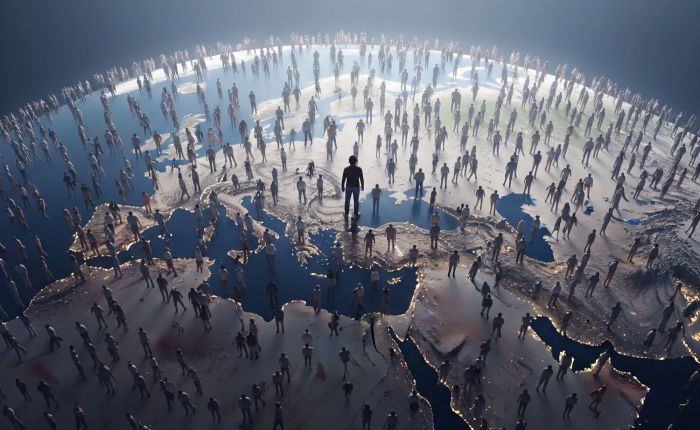
There are 8 BILLION people on the planet. Considering that number, my reputation is not at stake as much as I think. Like me, you need to NOT let those 12 job-related encounters–or even 30–establish your baseline identity or character.
To reiterate, maybe the successful people in the world had the right 150- 300 at there disposal from the very beginning. They had people who were cheerful, positive, successful themselves, happy, open to new ideas–philosophically minded, dreamers and willing to keep working at it and trying etc. Those are the kind of collaborators you want. If you don’t have them now, you can change things up. You can use the vast numbers of people who navigate the internet as a potential wellspring to draw from.
These are trite, already known thoughts. But the point is you must constantly remind yourself that there are 8 Billion people to exploit.
Maybe you can’t change things up right now. But at least you can remember THE LAW OF LARGE NUMBERS. That is, despite the common mantra “It’s a small world after all”. It really isn’t. There are 8 BILLION PEOPLE to exhaust your resources, time, attention and talents. There isn’t enough time in your life to remotely scratch the surface or all that’s out there. “The tip of the iceberg” platitude doesn’t even BEGIN to convey how FEW PEOPLE YOU’VE really interacted with or even more, formed a meaningful connection with or could have an impact on.
Don’t let those 5 people at your company/work determine who you are. Even if you’ve ruined your reputation at an entire company, remember there are literally millions of companies globally that you could reach out to or that may find your skills or personality admirable. BEEN IN PRISON? Guess what? If you’re out, there are TONS OF POTENTIAL opportunities if you’ve truly committed to a crime-free life and you have a willful determination to make something of yourself. There are literally thousands of countries where you could stake out your next project or business pursuit.
Remember the doctor who killed Michael Jackson? Guess what? In 2023 he successfully opened his own medical institute in San Juan and also in Trinidad and Tobago. He is back to not only being a successful doctor, but developing thriving clinics.
The odds are in your favor because the global population is enormous. And don’t let me get started with your ability to use AI and use it to carve out even more bifurcations that lead to EVEN MORE OPPORTUNITIES. Imagine the global population surging with robots? That’s even more “people” to work with.
There are so many mistakes you can make with different people and yet still billions of more people to “try it out on”. And, if you were making some sort of cardinal, egregious mistake, that mistake will eventually be corrected or modified after so many iterations and interactions with different people. You just have to keep reaching out to more people.
To conclude, remember that your REPUTATION isn’t a single, monolithic thing. It’s really just a bunch of perceptions held by different people in different contexts. A gaffe in one area may be unknown or irrelevant to other people who are not in your direct circle. Most people–even that small group of 150 to 300 that you might engage with yearly–are too busy to care about your mistakes for too long because they have their own lives to dwell on and their own mistakes.There will always be TONS of people on the globe for you to work with and have an impact on.

 A Slice of My Trash, Travels and Tots