
I know what you’re thinking, “That’s a terrible title”. No it isn’t. You clicked on it. And net traffic as well as ‘time spent on a site’ is the best indicator for Google’s ranking of your content.
We have 1 television (1 TELEVISION) in our home and it’s in our bedroom. I firmly believe that young children should be exposed to very few (if any) weekly screen-hours as possible.
But why? Aren’t there plenty of educational programs that act as free babysitters? Yes. Most are these days. Why rant against T.V’s or screens?
It’s really not so much what your children watch on a screen, but how long they watch it and how emotionally affected and attached they become to it. Since I never developed the habit of “T.V. watching” during childhood, I’m a bit biased. You’re free to scroll past this post if it bothers you. I know there will be plenty who disagree.
I tend to see T.V.’s net benefits as: 1. Fun entertainment that dampens original ideas and 2. time waster (which, I guess, isn’t a net benefit, is it?).
Compared to most of my peers, I spent very few hours seated in front of a screen or even watching movies. But this wasn’t because my parents thought that TV resulted in a “lack of original thinking” or that it “suppressed imagination” (i.e. the reason many educated parents limit T.V. viewing). My mother would comment that television was “too sarcastic” and that it didn’t “provide good morals”. Hence, my brothers and I were not allowed to watch The Smurfs.
We were allowed to watch endless episodes of Leave it to Beaver and my parent’s bought plenty of wholesome Christian inspired movies for us to watch. These were not very enticing. Needless to say, with these alternatives, I simply stopped watching screens. Sure, I watched a few movies here and there throughout my childhood and teen years, but certainly not enough to be able to recognize even the most well-known stars.
So, what’s really the problem with T.V./screens then?
In the end, what TV does is it makes everything else in life seem boring. That’s it. Life is already quite boring for most adults. For young children, the television seems to quickly desensitize them to their once bright and novel surroundings–those things ready to be used for unstructured play–and makes them seem comparably boring.
Furthermore, television, movies and social media homogenize. They make a bunch of people who all talk and think, more or less the same. It encourages a sort of mindlessness. Ever notice how people are seemingly always quoting from movies instead of coming up with their own phrases?
We know that most adults have already been desensitized and/or spoiled to some degree. Children, unless exposed to lots of screen-time, still maintain an air of unspoiled excitement for the mundane. I think its preferable for children to hold onto this tendency as long as they can. It will eventually teach them how to create their own solutions for boredom–how to transcend boredom using their very own intellect and imagination. They might discover hobbies, educational pursuits or even entrepreneurial ventures in the mist of being bored. And this is because they are forced to find a remedy for boredom on their own.
Being able to defer gratification and envision the bigger “future reward” is a skill that can be developed at a young age. I think it’s very important to help your children hone this skill.
A couple months ago we were letting our tot watch 2-3 episodes of a children’s program from Amazon each week. It’s called “Tumble Leaf”. I noticed that on the days that she viewed, she became increasingly angry–even hostile–once the show was switched off. She would throw tantrums–as if she was having withdrawal from her favorite drug. She would screech and thrash on the floor for long periods after the television was off. This made me realize that she was really developing an unhealthy attachment to this program.
The past few weeks she has not been viewing any screens. Before Tumble Leaf, the only shows/movies she watched were: Bambi, Dumbo, Snow White and a few nursery rhyme songs on YouTube (only a couple times each month–at most, and it was when we were in a restaurant or some other public venue where she wouldn’t sit still.)
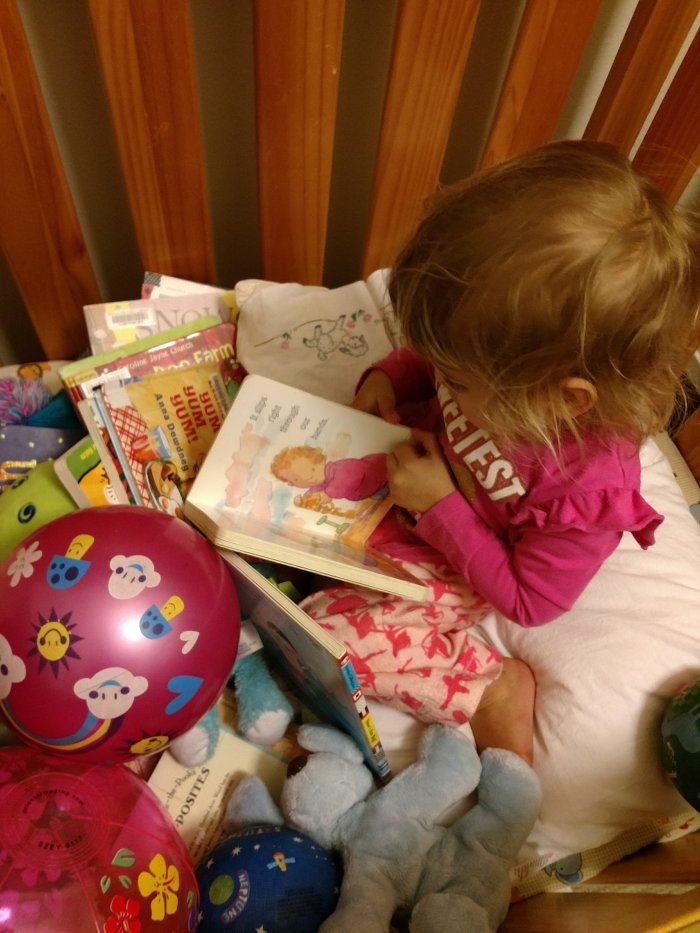
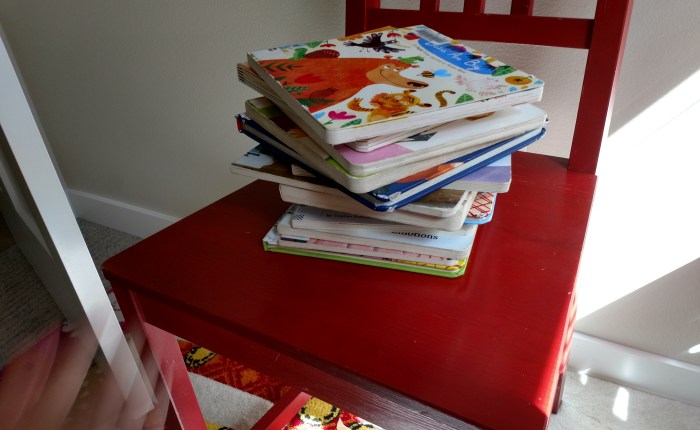
In other news, I’ve started to incorporate weekly LIBRARY TRIPS into our schedule. I’ve been very consistent the past couple of months. Every week we go to one of the libraries here in our city and I pick out 15-30 books for her each time. This way, at night, after I read to her and tuck her in and she begins her 2 hour screamfest, she ends up being distracted by her new library books. She will sit and look through them until she falls asleep. This is a great way of preparing her to be a future reader while also calming her down before bed.
Turning the pages of a book is much slower-paced than television, computers, tablets or phone screens. There is a much-needed confining or “restricting” quality to books. She learns to delay instant gratification–because she has to go through the physical effort to turn the page in order to find out what comes next.
Compared to a screen, she will likely spend more time on each page, looking at all the interesting pictures, colors and letters without being constantly offered the opportunity to “click elsewhere”–as you see on YouTube videos. She will develop a strengthened attention span as she appreciates all that she is seeing on each page. She might also want to go back to a previous page, and look for what she may have missed. By starting with books, I believe this will instill a deeper and fuller approach to learning…ANY SUBJECT. It kind of paves the way for “how to learn”.
It is this slow, methodical approach to learning that can teach your child how to learn all things.
In the end, it will be books–more than any other object in your home– that will prepare your child’s mind for school learning. They will need the necessary skills to sit still at a desk for a period of time to listen to the “boring teacher” and to read/go-over the “boring paper materials” and books presented to them without constantly jumping from one thing to the next.
I’m willing to bet that over time, a phone, tablet or other screen-type device will inadvertently teach your children how not to focus. I’m convinced that these devices will teach your children to become dependent on them for ALL (or, most all) of their fun.





 A Slice of My Trash, Travels and Tots