PEOPLE TELL YOU NOT TO POST CONTROVERSIAL OR PROVACATIVE IDEAS ON FACEBOOK

PEOPLE TELL YOU NOT TO POST CONTROVERSIAL OR PROVACATIVE IDEAS ON FACEBOOK

This is something that I want you to remember: the next time someone tells you not to post a controversial or provocative Facebook post or the next time they chide you “Facebook is not the place”, you can remind them of this:

  • Nobody (or, almost no one) reads a dense non-fiction book to completion. They skip around or don’t finish it.
  • Fewer people are reading lengthy articles on the internet of any kind.
  • Fewer people are reading at all.
  • When people are “reading” they’re usually scrolling and capturing quick, short bits of information in a hurry.

The next thing you can mention is the EVIDENCE STRONGLY SUGGESTS that people spend LOTS of time hovering over and READING comments from various Facebook posters/accounts, especially if the posts are intriguing, controversial or even just slightly provocative.

I’m not talking about near nudity or explicit posts that generate the SAME kind of expected commentary. I’m referring to written posts that nudge people to read and then respond with their own intellectual take or perhaps push back with a logical and fact based retort. People are often considering all the other comments before posting their own. They don’t want to sound like they’re just repeating the same thing but have taken the time to think about the various comments and have arrived at a slightly nuanced angle. In other words, they END UP SPENDING MORE TIME on that post with lots of comments.

People are naturally curious. People also don’t always have the time to plow through a dense book that may be regarded as controversial. But somehow Facebook analytics and all the research we have until now suggests that people DO spend quite a bit of time in comment sections. If they’re not actively responding, their passively reading. And posts that make a person think for a moment will always generate more engagement, more time spent on that post.

This nonsense BS that FACEBOOK IS NOT THE PLACE TO POST SOME IDEA is NOT backed by evidence or what people are ACTUALLY engaged by or act upon. By far, Facebook is the place because people are more likely to be actively scrolling through Facebook than to be flipping through the pages of book–even if the book is controversial or engaging.

We need to rethink the common phrase “Facebook is not the place”. If you’re a digital creator, Facebook is most certainly the place. Of course you can lose followers but your reach directly expands for potential new followers or friends. Also, the algorithm constantly takes notes. It sees beyond quick likes where people scroll past rapidly vs. people hovering and reading and actually being fully immersed in a post or a string up comments below the post–even if they don’t click “like”.

I recently discovered that length of time spent is a STRONGER INDICATOR of reach and engagement than likes. Someone won’t like your post but they’ll hover over it and spend their precious time on it anonymously. Always remember that. The algorithm knows.

So if you have any interest in success measures like MAKING MONEY $$$$$$ or building a FOLLOWING in the digital sphere, you’ll need to rethink these overused expressions that really don’t have any bearing on reality.

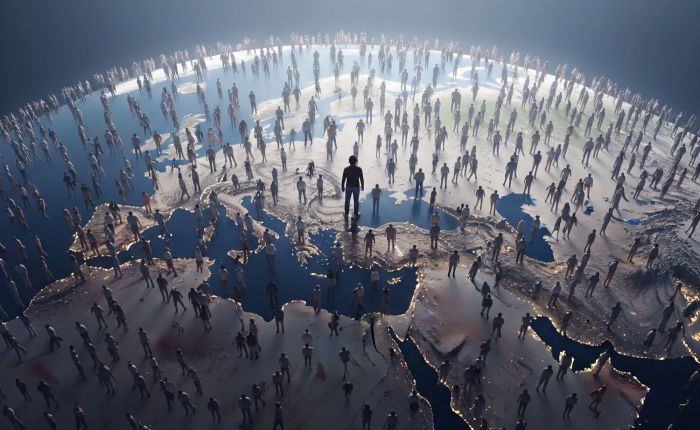
THE 300 PEOPLE YOU INTERACT WITH IS ONLY 0.00000375 of 8.2 BILLION PEOPLE/GLOBAL POPULATION

THE 300 PEOPLE YOU INTERACT WITH IS ONLY 0.00000375 of 8.2 BILLION PEOPLE/GLOBAL POPULATION

You probably have more options than you realize. You probably have more reach. With the modern digital landscape, you can be influential because your ability to expand, grow and be recognized by a larger number of people is so much more ample. Meanwhile, your everyday life experience may be limited by the number of people you encounter and form both shallow and profound relationships with.

Dunbar’s number suggests that most people interact with and form stable relationships with 150 to 300 people in their life (and that’s a generous range!). The problem with these 150 to 300 people that we mostly see and interact with is that they provide a very limited “small pond” effect to our brains. This is a cognitive bias.

Thus, in reality, we interact with a VERY SMALL FRACTION of the global population. It’s impossible for our brains to internalize the vastness, the scale of it all. Instead, we rely on our limited understanding to gauge the world–especially OURSELVES IN THIS WORLD. Our thoughts regarding our opportunities, chances and options are simultaneously shrunk down to size.

We start to judge ourselves based on the overall tenor and consensus of how these 0.00000375 people in the global population respond to us. We’re constantly worrying about our character and how it is being perceived, evaluated, from the metrics coming from that very small population we are working with. For example, if we get fired, a few times (or even many times!) we assume our experience of ourselves is representative of THE LARGER REALITY.

If we blow it on our blog–with our you tube channel—with our social media posts- or even with something like the kiosk that we run at our local Farmer’s Market–WE ASSUME THAT WE HAVE A FIXED AUDIENCE or FIXED CLIENTS/PATRONS. You do not.

If you’re like me, your blog will attract some people from Pakistan one day and people from Iceland another day. Audiences change. People grow out of what you have to say. People find newer, fresher, younger faces or maybe they remember you and come back. You still have a chance to grow and have influence and success if you manage to hook even just a few people. You have to make people remember you.

Back to what I was saying earlier, if most of those people “in your current circle” think a certain way, have very different personality traits than we do, or are super judgmental, you’ll start to regard yourself through the same lens. Perhaps these individuals don’t make any outright negative statements–only little ones that diminish you or make you feel “you don’t have what it takes”, “You’re incomplete” or “You’re not there yet”.

Because of our cognitive biases, we project the opinions of a HANDFUL of certain people onto an entire hypothetical “public”. If our boss or work mates show disappointment for our idea, we feel like EVERYONE is disappointed with it. If a particular social group show’s aversion or dissatisfaction for your choices, it can feel like your’re just a general loser.

Often, we inflate the long-term impact of a single mistake.

We start to think that that circle of people defines who we are. Or, that must be the way the world is. But maybe we have it wrong. Maybe we just have the wrong 150-300 people in our circle from the get-go. Maybe we’ve been dealt a bad hand of people from the start.

Maybe someone like Steve Jobs had a bunch of “the right” people around him at the right time. Without that specific concoction of people, maybe he would have never had the sustained inspiration to carve out a successful path and put his ideas out there.

Afterall, it’s easier to try new things and throw our ideas out there with the right kind of people surrounding us. It’s much harder when we feel fear of what kind of half-hearted commentary we’re going to receive or worse, someone who changes the subject to talk about “the weather” a “recent event” or something very mundane like something they noticed about a particular street, car, celebrity, place. It can feel dismissive and boring at the same time.

My go-to thought when I’m feeling like I’ve been handed the wrong surrounding of people:

There are 8 BILLION people on the planet. Considering that number, my reputation is not at stake as much as I think. Like me, you need to NOT let those 12 job-related encounters–or even 30–establish your baseline identity or character.

To reiterate, maybe the successful people in the world had the right 150- 300 at there disposal from the very beginning. They had people who were cheerful, positive, successful themselves, happy, open to new ideas–philosophically minded, dreamers and willing to keep working at it and trying etc. Those are the kind of collaborators you want. If you don’t have them now, you can change things up. You can use the vast numbers of people who navigate the internet as a potential wellspring to draw from.

These are trite, already known thoughts. But the point is you must constantly remind yourself that there are 8 Billion people to exploit.

Maybe you can’t change things up right now. But at least you can remember THE LAW OF LARGE NUMBERS. That is, despite the common mantra “It’s a small world after all”. It really isn’t. There are 8 BILLION PEOPLE to exhaust your resources, time, attention and talents. There isn’t enough time in your life to remotely scratch the surface or all that’s out there. “The tip of the iceberg” platitude doesn’t even BEGIN to convey how FEW PEOPLE YOU’VE really interacted with or even more, formed a meaningful connection with or could have an impact on.

Don’t let those 5 people at your company/work determine who you are. Even if you’ve ruined your reputation at an entire company, remember there are literally millions of companies globally that you could reach out to or that may find your skills or personality admirable. BEEN IN PRISON? Guess what? If you’re out, there are TONS OF POTENTIAL opportunities if you’ve truly committed to a crime-free life and you have a willful determination to make something of yourself. There are literally thousands of countries where you could stake out your next project or business pursuit.

Remember the doctor who killed Michael Jackson? Guess what? In 2023 he successfully opened his own medical institute in San Juan and also in Trinidad and Tobago. He is back to not only being a successful doctor, but developing thriving clinics.

The odds are in your favor because the global population is enormous. And don’t let me get started with your ability to use AI and use it to carve out even more bifurcations that lead to EVEN MORE OPPORTUNITIES. Imagine the global population surging with robots? That’s even more “people” to work with.

There are so many mistakes you can make with different people and yet still billions of more people to “try it out on”. And, if you were making some sort of cardinal, egregious mistake, that mistake will eventually be corrected or modified after so many iterations and interactions with different people. You just have to keep reaching out to more people.

To conclude, remember that your REPUTATION isn’t a single, monolithic thing. It’s really just a bunch of perceptions held by different people in different contexts. A gaffe in one area may be unknown or irrelevant to other people who are not in your direct circle. Most people–even that small group of 150 to 300 that you might engage with yearly–are too busy to care about your mistakes for too long because they have their own lives to dwell on and their own mistakes.There will always be TONS of people on the globe for you to work with and have an impact on.

SOCIAL MEDIA “CREATOR TYPES” ADVANTAGE!

The SOCIAL MEDIA SPHERE may already be saturated with accounts.

Here are a few things to remember while you’re vying for presence, subscribers, followers, noticeability, views and engagement:

It will always be easier to CLICK and SCROLL and CONSUME than to CREATE and to create regularly.

There will always be MORE PEOPLE in the population willing to waste several minutes of their day (and from the research literature, SEVERAL HOURS) scrolling than several minutes CREATING. Always. This is a fact. The most rudimentary fact of human nature is probably our tendency towards ease. We have an entire country filled with health problems and obesity, not bodybuilders. And most of this can be attributed towards our human tendency towards relaxation, comfort and often laziness.

Humans choose the easier path. This is good otherwise we wouldn’t have invented technology in the first place. But this is also good for YOU because it means that you as a content creator or blog-post writer or aspiring influencer have a distinct advantage.

Remember, you want to create. You LOVE the process, the act of creating both physical items and digital items. You’re spurred not solely by gaining some kind of number or position but simply by the fact that you love the creative flow you experience while making anything. You know what this feels like. You’ve done it before. You know how much better you feel after you’ve put in some effort. Sure, you’re flawed. Sure, other people will notice too, but you’re on this creative trajectory.

Think of it like this: some people try to acquire a college education for the sake of getting good grades or simply for the high paying career at the end. Other folks pursue education because they enjoy amassing tangible and abstract truths about the world. They love the interplay between disparate things. They love the “Aha moment” when they discover a useful link with something they’ve learned. They learn because they know it enriches their character, performance and intelligence. Learning becomes a long-term life goal.

In the same way, creator types who want to create and have that instinctive drive to create, are not motivated by gaining a following or establishing some kind of internet notoriety or making lots of money.

While it may be fun to track your progress and to see the views you’re getting, it’s even more fun to jump back into the act of creating, producing and synthesizing relatable ideas.

As much as I try to take a break from posting on various social media platforms, I find myself inexorably compelled to create and post whether it is my art attempts, my woodworking creations, my decorations, my gardening activities, my children’s summer fun moments etc.

I enjoy the process of making original stories on Facebook or composing short reels. I like posting on my ART facebook page. I like wrestling with my thoughts in my blog. I like attempting Shorts on Youtube every-once-in-a-while. I have an entirely separate blog where I posted philosophical ideas for YEARS and it has almost 300,000 views but only 98 subscribers. And, while I haven’t posted there for over a decade, I’m still gaining views! My 2009 posts are still getting views.

If the above felt relatable, you know you’re certainly a “creator type” and you have an edge already. You have intrinsic motivation and nothing can ever take that away because you’ve felt it too many times before. You notice you spend hours making things but only minutes (or less) scrolling. If that’s you, YOU HAVE WHAT IT TAKES!

Think of all the BIG content creators out there. Do you think they spend a ton of time or effort scrolling through other people’s content? My guess is RARELY. They’re going to have to spend tons of their time working on, editing and thinking about THEIR NEXT PIECE OF CONTENT. It becomes a constant pursuit for them. And believe me, when they start to grow, it’s even more time consuming. So NO, they’re NOT SPENDING VERY MUCH TIME SCROLLING. I can guarantee where they’re spending their moments. They spend their time thinking about their projects and tossing around ideas for their next one.

The only thing you need to do is to convert SOME OF THAT TIME STARING AT YOUR PHONE BRIEFLY ON THOSE BIG ACCOUNTS TOWARDS directly working on your own projects. It’s a habit that you must inculcate into your brain. If you’re going to spend any time in the social media sphere, always do it for you!